
We’ve created a game to raise fan engagement through WhatsApp
Recording an audio message in the shape of a city skyline turned out to be a great idea for booth engagement.

At WeAreDevelopers Berlin in July 2024, the most active participant at our conference booth sent 460 voice recordings over three days, each one a fresh attempt to improve their score and move up the leaderboard in a simple game called Vocalize.
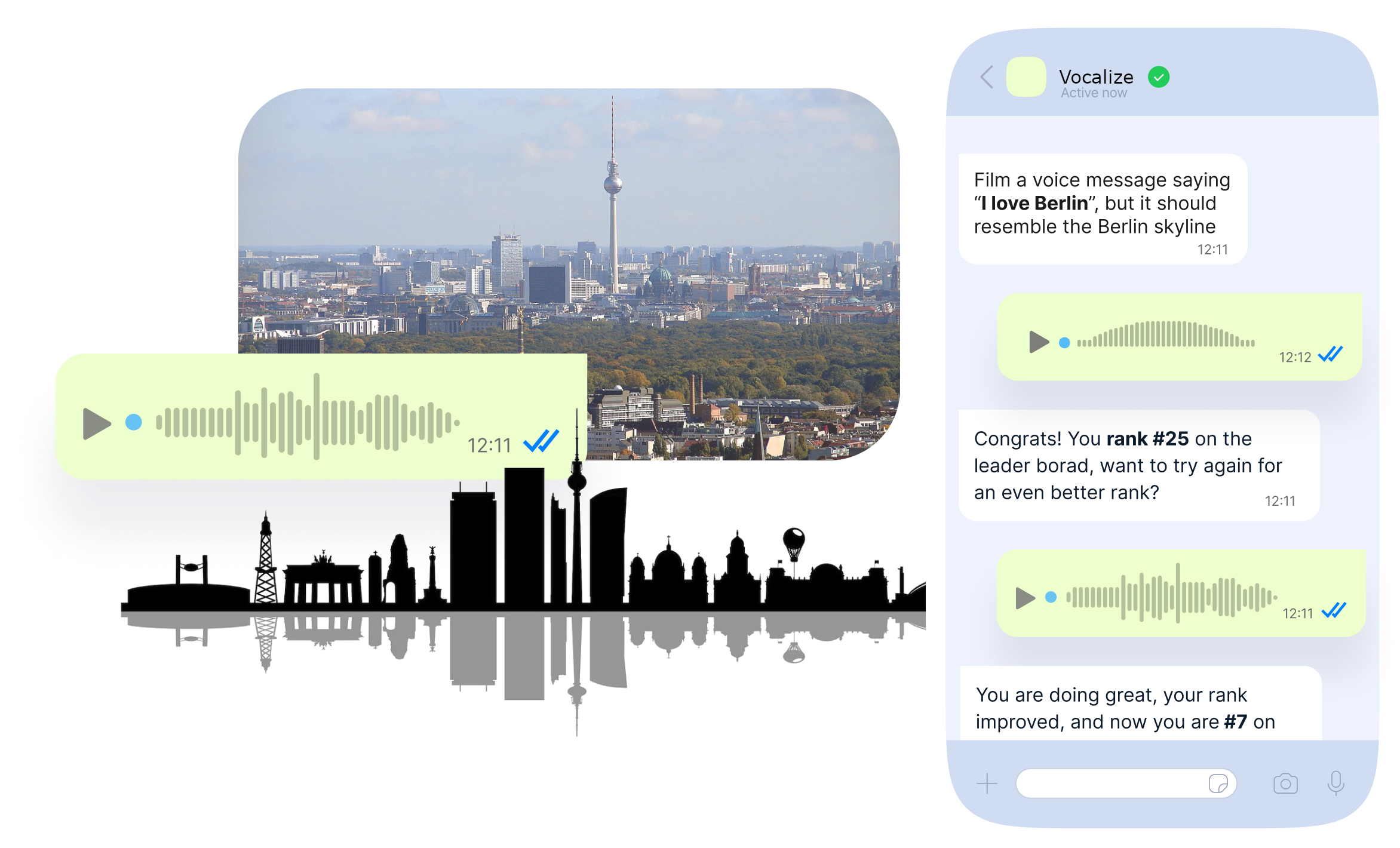
The game runs over WhatsApp and is used for entertainment and engagement. You scan a QR code at the booth, open a conversation, and receive a challenge. Then you need to record a voice message saying a target phrase (in this particular case, for Berlin, “I love Berlin”) while making the shape of your audio waveform match a visual contour. For Berlin, the shape was the city’s skyline.
The image is not chosen arbitrarily. Vocalize requires a black foreground silhouette on a white background with rough bilateral symmetry, a contour a waveform can plausibly trace. City skylines qualify for this reason, as do mountain ridgelines, tree lines, and wave crests. The Berlin skyline fits exactly.
Every recording then gets scored on two dimensions: how accurately you said the phrase, measured using a modified Levenshtein distance algorithm, and how closely your waveform’s shape matches the target contour, compared across 40 segments. After each attempt, a chatbot returns your score, your leaderboard position, and exactly how many points separate you from the next rank.
That last detail, the gap, is where the loop begins.
Great initial results
We deployed Vocalize at four live events in 2024: WeAreDevelopers in Berlin, KulenDayz in Osijek, GOTO Chicago, and Web Summit in Lisbon. Across all four, we collected a total of 12,456 voice recordings. Our aim was to test whether a gamified voice competition, running entirely over an app 3 billion people already have on their phones, could generate leads with genuine intent, rather than the badge scans and brief demos that most conference booths produce.
Lead conversion ended up being quite strong. At three of the four events, around 71% of everyone who sent an initial message completed registration. At WeAreDevelopers, 64% became recurring participants. But the more interesting finding was in how the recordings were distributed.
At WeAreDevelopers, 24% of participants sent 80% of all voice messages. At Web Summit the same 80% came from 12.54% of participants. At KulenDayz and GOTO Chicago, the results were more or less similar. Turns out that a small group found the competition at each event, discovered the feedback loop, and just kept going.
The distribution matches the Pareto principle (80% of consequences come from 20% of causes). Scoring, ranking, and the precise gap to the next position turned each attempt into a tractable problem: one recording was never quite enough. The most active participant at WeAreDevelopers sent 460 recordings, at GOTO Chicago it was 381, at KulenDayz 259, at Web Summit 298.
Switching it up
At Web Summit, we decided to switch things up a bit, and run something else along with the main game to see what happens and how it affects engagement.
For that event, we added a RAG-powered Q&A layer that worked like this: attendees could ask the chatbot questions about Vocalize without entering the competition.
This resulted in more ways to engage with the product and more surface for brand awareness. Recurring participation at Web Summit came in at 27.58%, compared to 60-69% at every other event. The ratio of voice to text messages was also flipped: where other events saw 75-87% of interactions as audio recordings, Web Summit was 65% text.
It turns out that people rather talked to the chatbot than play the game.
The team notes this remains a hypothesis. However, the data points in one direction: adding a way to engage with the product without entering the competition gave people an off-ramp from the part that was actually working.
The feedback loop that produced 460 attempts at WeAreDevelopers depended on the leaderboard being the only thing worth doing. When we tried to route around it, the appeal and the “pull” of the loop weakened.
More functions, less engagement?
For anyone building AI-assisted customer experiences on Infobip’s Answers platform, both findings mentioned above carry weight. The engagement data shows that conversational mechanics with real-time scoring and competitive feedback can generate the kind of participation that most lead acquisition approaches cannot.
The Web Summit data is the harder lesson here: more functionality can reduce engagement and sometimes the most effective way for making a chatbot is the one with the least amount of possible exits.
Vocalize is built on a standalone API and uses Infobip’s Answers platform with WhatsApp integration, using Whisper for speech recognition and OpenAI models for the conversational layer.
The work comes from Edvin Teskeredzic, Muamer Paric, Adna Sestic, Hadzem Hadzic, and Kemal Altwlkany at Infobip BiH, and Petra Fribert, Anamarija Lukac, and Emanuel Lacic at Infobip Croatia. The paper was presented at HT Adjunct 2025.
Full paper is avilable at arxiv.org/abs/2507.20730